

Blood Clot Treatment in Watauga, TX
Most blood clots get blamed on something else first: a pulled calf, a long day on your feet, a chest cold that won’t clear. That delay is where the danger sits. Blood clot treatment at ER of Watauga starts by testing the explanation you’ve been given, with a D-dimer blood test, Doppler ultrasound of the leg, and CT imaging of the lungs when breathing is involved. If a clot is there, treatment to stop it from growing starts before you leave.
Sudden shortness of breath, chest pain, or fainting? Call 911 now.
Call Now: (817) 945-5500
Hours: 24/7/365
Walk-In: 5401 Basswood Blvd, Fort Worth, TX 76137, United States
If It's in Your Chest, Call 911 First
A clot that reaches the lungs can strain the heart within minutes, and paramedics can monitor your rhythm and give oxygen on the way. Sudden breathlessness at rest, chest pain that sharpens with each breath, a racing heartbeat, fainting, or coughing up blood are 911 symptoms, not drive-yourself symptoms.
The patients who walk through our doors are usually in a quieter situation: one calf that has ached and swelled for a day or two, breathlessness on the stairs that’s new since a surgery or a long trip, or a nagging feeling that something isn’t right. That’s exactly the uncertainty an emergency evaluation is built to settle.
What a Clot Gets Mistaken For
A clot rarely announces itself. These are the explanations people give us most often, and the detail that makes us look for a clot anyway.
| What it seems like | Why it could be a clot instead |
|---|---|
| A pulled calf muscle | No strain or injury you can remember, and the ache gets worse over days instead of better |
| A charley horse | The cramp doesn't release when you stretch, and the calf stays tight and tender |
| Swelling from standing all day | It's swelling in one leg only, and it hasn't gone down after a night with your feet up |
| A sprain or bruise | The skin is warm, reddish, or looks stretched, with no injury to explain it |
| A chest cold or bronchitis | Breathlessness that came on quickly, with little fever and no real congestion |
| Anxiety or a panic attack | The racing heart and short breath don't settle once you calm down |
| Being out of shape | You're suddenly winded doing things that were easy a week ago |
Calf pain in one leg plus any of these risk factors is reason enough for an ultrasound. Our article onpain that sharpens with each breath explains how a lung clot differs from pleurisy and other chest causes.
The Weeks When a Clot Is Most Likely

Clots tend to follow events. If one of these happened recently and your leg or breathing changed afterward, mention it the moment you arrive.
After surgery. Risk stays raised for several weeks, and for hip and knee replacements it can last up to three months.
After giving birth. The first six weeks after delivery carry a higher risk than pregnancy itself, and C-sections raise it further.
After a long drive or flight. Four hours or more of sitting slows blood flow in the legs. That includes long-haul drivers working the freight corridor around Alliance and anyone flying home through DFW.
In a cast, boot, or brace. A leg that can’t move keeps blood pooled in its veins.
On estrogen. Birth control pills, patches, rings, and hormone therapy all raise clotting risk, more so in smokers.
With cancer, a recent hospital stay, or a past clot. Each of these makes a new clot more likely, and a past clot is the strongest predictor of another.
Clots That Don't Start in the Leg
Not every deep vein clot forms in the calf or thigh. Arm clots can follow an IV line, a PICC line, or a pacemaker wire, and they also show up in young, fit people after heavy overhead lifting or repetitive throwing. The signs mirror a leg clot: one arm swells, feels heavy, and turns slightly blue or red, sometimes with visible veins across the shoulder.
These are less likely to travel to the lungs than leg clots, but they still need an ultrasound and treatment, and the cause often needs attention too.
How We Find a Clot

- A risk assessment and a D-dimer. Your symptoms and history set the starting probability. When it’s low, a normal D-dimer from our onsite lab can rule a clot out without imaging.
- Doppler ultrasound of the leg or arm. If the D-dimer is raised or suspicion is high, ultrasound looks directly at the deep veins and shows whether blood is flowing through them.
- CT imaging of the lungs. When breathing or chest pain is part of the picture, a contrast CT scan shows whether a clot has lodged in the lung arteries.
- Heart strain checks. An EKG and cardiac enzyme testing show whether a lung clot is putting pressure on the heart, which shapes what happens next.
Most patients have an answer within a couple of hours, and blood clot treatment can begin as soon as the picture is clear.
Blood Clot Treatment, Here and Beyond
Treatment starts as soon as a clot is confirmed, and sometimes sooner when suspicion is high. DVT treatment centers on blood thinners, which stop the clot from growing while your body breaks it down. Many people with a leg clot start that medication here and go home the same day with a clear plan and follow-up.
A clot in the lungs is assessed more carefully. Smaller clots in stable patients can sometimes be managed at home. Larger clots, or any sign the heart is under strain, mean hospital admission. We don’t give clot-dissolving medication or perform clot-removal procedures here. When those are needed, we stabilize you, start treatment, and arrange the transfer with your imaging and results sent ahead, so the hospital team acts on a confirmed diagnosis instead of starting over.

Why Patients Choose ER of Watauga for Blood Clot Treatment
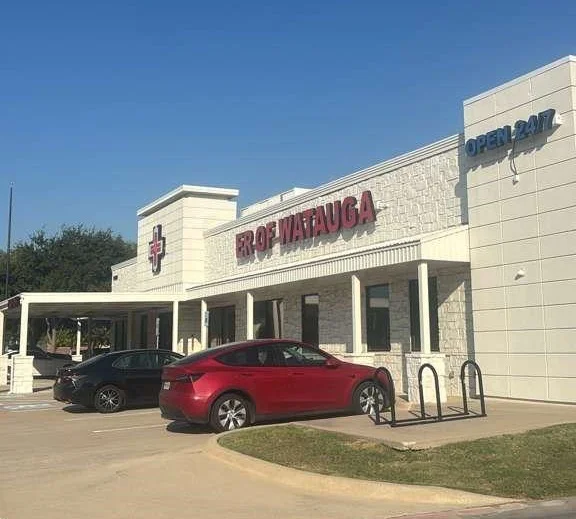
- Ultrasound, CT, and D-dimer under one roof, so a suspected clot gets confirmed or ruled out in a single visit.
- No referral needed for imaging, any hour, including nights and weekends.
- A plan that matches the clot, with blood clot treatment that ranges from going home on blood thinners to a direct hospital transfer.
- Board-certified emergency physicians on site around the clock.
- Care that fits your budget. We accept most major insurance plans and offer flexible payment plans through Sunbit, and state law requires emergency visits to be processed at in-network benefit levels.
ER for Blood Clot Near Watauga
When you need an ER for blood clot concerns and your doctor’s office is closed, ER of Watauga is open on Basswood Boulevard every day of the year. We provide blood clot treatment in Watauga for patients from Haltom City, Keller, North Richland Hills, Saginaw, Haslet, Fort Worth and the surrounding areas.
If you’ve just come off a long drive or flight, bring your travel dates. If you’ve had recent surgery, bring the date and the procedure name. Both change how we read your results.
One Swollen Calf Is Enough Reason. Come In Today.

Swelling in one leg, a calf that keeps aching, or breathlessness that’s new since a surgery or a trip doesn’t need to get worse before it’s worth checking. An ultrasound takes minutes. Waiting gives a clot time to grow or move, and the symptoms that bring most people in are far easier to treat early than late.
Walk in anytime at 5401 Basswood Blvd. Blood clot treatment can start the same visit, and you’ll leave knowing whether there’s a clot at all.
Call Now: (817) 945-5500
Hours: 24/7/365
Walk-In: 5401 Basswood Blvd, Fort Worth, TX 76137, United States
FAQs
Can a blood clot in the leg go away on its own?
Small clots sometimes dissolve without treatment, but there’s no way to know which ones will. An untreated deep vein clot can grow, break off, and travel to the lungs. That’s why physicians treat confirmed deep vein clots with blood thinners rather than waiting to see what happens.
Should I massage or stretch a leg that might have a clot?
No. Rubbing, massaging, or aggressively stretching a calf with a possible clot isn’t recommended, and heat won’t treat it either. Keep the leg as comfortable as you can and get it checked. If a clot is ruled out, you can go back to treating it like a muscle problem.
Can you have a blood clot without swelling?
Yes. Some leg clots cause only aching, tenderness, or a feeling of heaviness, especially early on. Lung clots often have no leg symptoms at all. Calf pain on one side with a recent surgery, delivery, long trip, or estrogen use is worth an ultrasound even if the leg looks normal.
Can urgent care check for a blood clot?
Most urgent care clinics can’t perform a Doppler ultrasound or CT scan on site, so a suspected clot usually means being sent somewhere else. An emergency room can test, confirm, and start DVT treatment in the same visit. OurER vs urgent care guide covers the differences.
Will I need to stay in the hospital for a blood clot?
Many leg clots are treated at home with blood thinners after an ER visit. A clot in the lung may need admission, depending on its size and how your heart and oxygen levels are coping. Your physician will explain which path fits your results before any decision is made.
Do I need an appointment, and what about insurance?
There’s no need for an appointment. You can walk in any hour, including weekends and holidays. We accept most major insurance plans and offer flexible payment plans through Sunbit. If you’re unsure whether your symptoms need an ER, call (817) 945-5500 and talk it through with our team.