

Stroke Emergency Room in Watauga, TX
A new stroke doesn’t feel new. It can feel exactly like the last one, which is why people who’ve already had one are often the most likely to wait. If you or someone with you has facial drooping, arm weakness, or slurred speech right now, call 911 first, even if it looks familiar. For everything else, ER of Watauga is a stroke emergency room built to evaluate fast, with on-site CT imaging, immediate lab work, and a board-certified physician reading results while you’re still in the room.
Call Now: (817) 945-5500
Hours: 24/7/365
Walk-In: 5401 Basswood Blvd, Fort Worth, TX 76137, United States
What Are the Signs of a Stroke?

The FAST test is the fastest way to check. Face drooping on one side, Arm weakness when both are raised, Speech that’s slurred or wrong, and Time to call 911 the moment any of these appear. These are the signs of a stroke whether it’s your first or your third.
Call 911 First. Here’s Why: Paramedics start assessing you the moment they arrive, run tests on the way to the hospital, and alert the receiving ER before you get there. That head start matters whether this is a first stroke or a second one.
- Face drooping: one side sags or feels numb, most visible when smiling
- Arm weakness: one arm drifts downward when both are raised
- Speech trouble: words come out slurred, garbled, or don’t make sense
- Sudden numbness: usually on one side of the body
- Vision changes: sudden blurred, double, or blacked-out vision
- Severe headache: a sudden, unusually severe headache with no clear cause
- Balance loss: sudden dizziness, stumbling, or loss of coordination
For stroke survivors, the sign most often misread isn’t a new symptom. It’s an old one. Weakness in the same arm, the same slurred word, feels familiar instead of urgent.
It Doesn't Feel New. That's Exactly the Problem.
If you’ve had a stroke before, a new one doesn’t necessarily announce itself as new. It can affect the same side, the same speech patterns, the same weakness you’ve already learned to recognize and, sometimes, learned to work around. That familiarity is exactly what makes it dangerous. A symptom that feels like an old, expected limitation is easy to dismiss as nothing new happening.
But a second stroke is a distinct medical event, it doesn’t borrow time from the first one. Whatever caused the original stroke, whether it was a clot, a narrowed artery, or an irregular heart rhythm, that same risk is often still present, and sometimes it’s what triggers the next event. Treating new or worsening symptoms as routine because they resemble old ones is how it gets missed.

The Year After a Stroke Is the Highest-Risk Year for the Next One

Recurrent stroke isn’t rare. Roughly one in four stroke survivors will have another one in their lifetime, and the risk is highest in the months immediately following the first event, not years down the road. Some research shows that risk climbing within just hours to days after a minor stroke or TIA, particularly in the first week.
This is why new or worsening neurological symptoms in a stroke survivor get the same urgency as a first-time case, not less. We evaluate what’s changed, check for the same risk factors that caused the original event, and look specifically for signs the underlying cause is still active. A history of stroke isn’t a reason to assume you already know what’s happening. It’s a reason to find out fast.
What Happens When You Arrive
Immediate Triage
A nurse checks vitals and current neurological signs within minutes of walk-in.
Stroke History
We ask about prior strokes, what those symptoms looked like, and what's different this time, this shapes how we interpret what you're feeling now.
CT Imaging
A non-contrast CT scan of the brain is read on-site, ruling out bleeding and helping determine what kind of event occurred.
Heart and Blood Work
A 12-lead EKG checks for atrial fibrillation, alongside bloodwork for clotting factors and blood sugar.
Continuous Monitoring
Blood pressure, heart rhythm, and neurological status are tracked while results come back. Most patients have answers within the hour.
Physician Evaluation & Coordination
A board-certified physician reviews every result with you and coordinates direct transfer if advanced stroke treatment is needed.
How We Evaluate and Stabilize a Stroke
Cause-Hunting, Especially With a Prior Stroke
Atrial fibrillation, uncontrolled hypertension, and narrowed arteries are checked in every evaluation, but they matter even more when there's a stroke history, since the original cause is often still active.
IV Fluids and Monitoring
If blood pressure needs stabilizing or the workup is still in progress, IV support keeps you steady without losing time.
Direct Coordination for Advanced Treatment
When a confirmed stroke needs reperfusion therapy or specialist intervention beyond what a freestanding ER performs, we stabilize, confirm imaging, and hand off directly to a receiving stroke center already briefed on your case, including your history, before you arrive there.
Honest Scope, Stated Upfront
We don't perform clot-dissolving treatment on-site. What we do is compress the clock before that treatment starts, whether this is a first stroke or a fourth.
Why Choose ER of Watauga for Stroke Care
If you’re comparing where to go for a stroke emergency room in Watauga, here’s what sets ER of Watauga apart:
Results in Minutes, Not Hours
On-site CT and lab results in minutes, so a stroke workup never waits on an off-site lab.
History Taken Seriously
Board-certified emergency physicians take stroke history seriously, not as a reason to assume less urgency.
Direct Stroke Center Coordination
When advanced treatment is needed, briefed on your full history before transfer.
No Triage Delays
For stroke-pattern symptoms, walk in and get seen immediately.
Every Symptom Evaluated on Its Own
Whether it's your first stroke or your third.
Care That Fits Your Budget
We accept most major insurance plans and offer flexible payment plans through Sunbit.
For billing queries, contact our billing department at:
Phone: (817) 785-8000
Email: info@aimbillingsolutions.com
Stroke Care Near You in Watauga
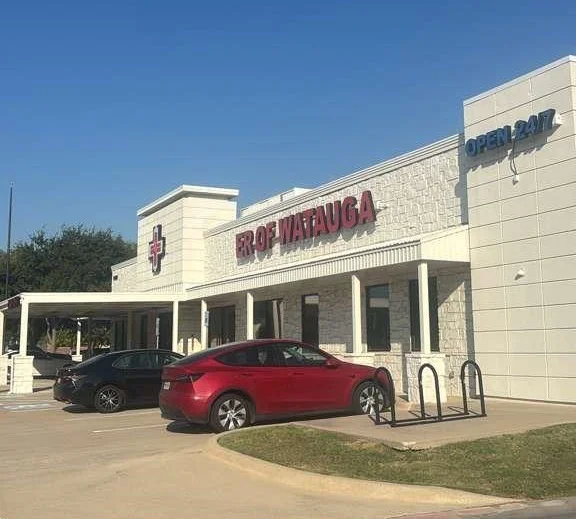
Searching for stroke care near me in Watauga? ER of Watauga sits centrally, minutes from Watauga, North Richland Hills, Haltom City, Keller, Saginaw, Fort Worth, Bedford, Hurst, and Richland Hills, with parking right outside the door.
We’re open 24 hours a day, 7 days a week, including every holiday, with on-site imaging and lab work ready the moment you walk in. Whether your stroke care near me search is for a first scare or a symptom you recognize from before, no appointment or referral is needed.
The Second One Doesn't Announce Itself Either

A first stroke teaches you what stroke symptoms feel like. It doesn’t guarantee the next one will feel any different, or that you’ll recognize it any faster.
ER of Watauga is open right now, every hour of every day, ready to treat every stroke like the emergency it is, whether it’s your first or one you’ve been through before.
Call Now: (817) 945-5500
Hours: 24/7/365
Walk-In: 5401 Basswood Blvd, Fort Worth, TX 76137, United States
Frequently Asked Questions
What are the signs of a stroke?
The FAST signs cover most cases: face drooping on one side, arm weakness when raised, and slurred or confused speech, with time to call 911 the moment symptoms start. Sudden numbness, vision changes, a severe headache, and loss of balance are also signs of a stroke and deserve the same urgency.
Can a second stroke feel the same as the first one?
Yes, and that’s part of why it’s dangerous. A second stroke can affect the same side of the body or the same speech patterns as the first, making it easy to mistake for an old symptom instead of a new emergency.
How soon can a second stroke happen after the first?
Recurrence risk is highest in the days and weeks immediately following a first stroke or TIA, not years later. Some research shows measurable risk within just 24 hours of a minor stroke, which is why new symptoms need immediate evaluation, not a wait-and-see approach.
Is a recurrent stroke worse than a first one?
Research suggests second strokes often cause more extensive damage and carry higher mortality than first strokes, partly because the brain has less healthy tissue left to compensate. That makes fast evaluation even more important the second time, not less.
Can urgent care evaluate stroke symptoms?
No. Urgent care clinics don’t have on-site CT imaging or the staff to manage a time-sensitive neurological emergency. Any stroke-pattern symptom, first-time or recurrent, needs a stroke emergency room evaluation, not a same-day clinic visit that can’t image the brain.
Should I mention my stroke history if I come in with new symptoms?
Yes, tell the team right away. Your stroke history shapes how quickly certain causes get investigated and helps distinguish a new event from a known, stable limitation, but it’s never a reason to assume new symptoms are old ones.
Do you accept insurance for stroke emergency room visits?
Yes. Walk in any hour without an appointment. We accept most major insurance plans and offer flexible payment plans through Sunbit for stroke emergency room visits and any other emergency care you need.