

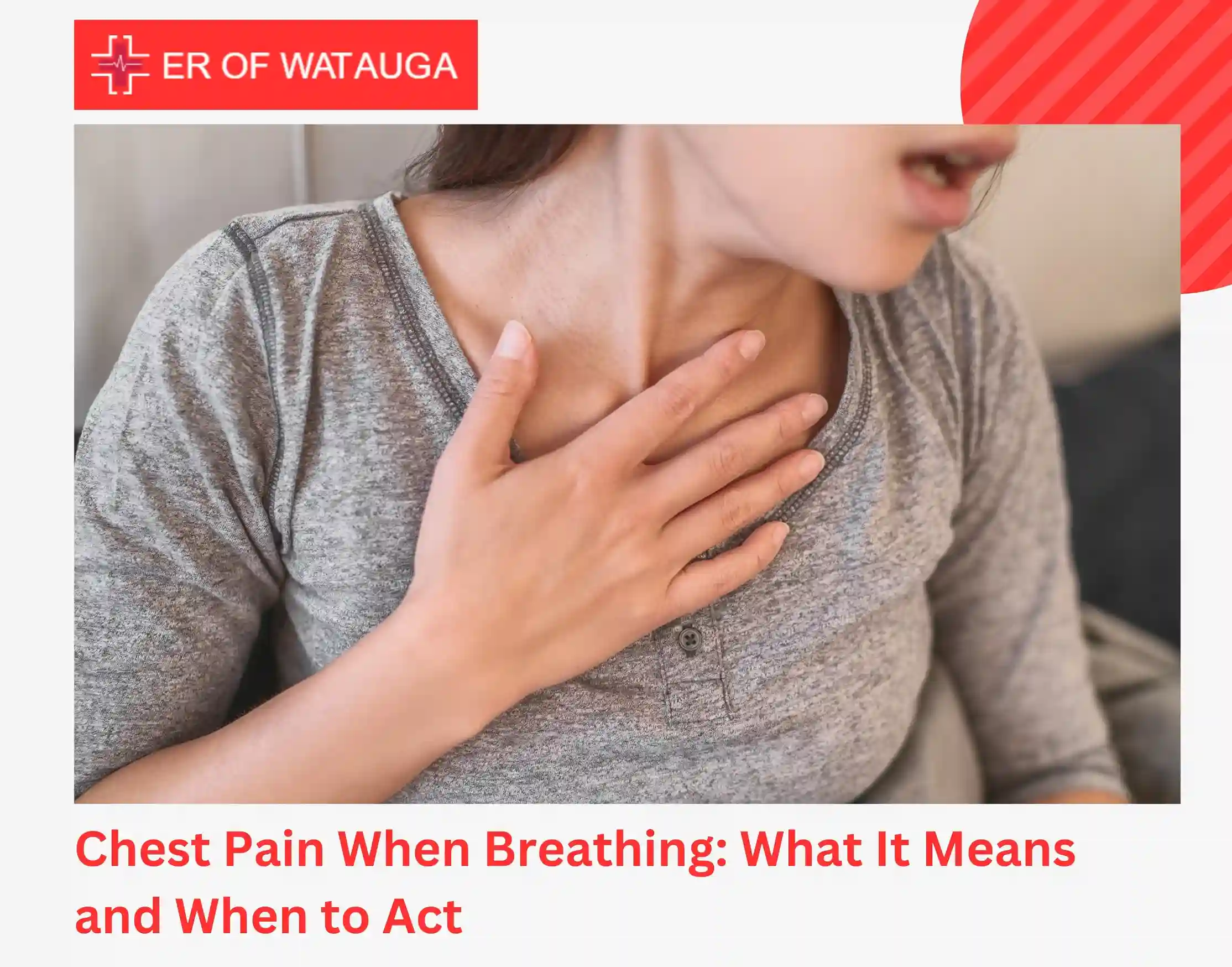
Chest pain when breathing tells you something specific: whatever is causing it moves with each breath. That narrows the field to the lungs, the membrane around them, the rib cartilage, or, more rarely, the heart.
Most cases trace to pleurisy or a chest muscle issue and resolve within days. A small minority signal a pulmonary embolism, the one cause that can’t wait. Knowing which presentation is which separates a doctor’s appointment from a 911 call.
What Causes Chest Pain When Breathing?
Chest pain when breathing usually comes from the lung lining (pleurisy), a lung infection, the heart sac, rib cartilage, or a chest wall muscle injury. Less common but more dangerous causes include a pulmonary embolism and a collapsed lung. Each presents with its own pattern of additional symptoms.
The eight most common causes fall along a clear severity gradient. Some clear in a week with rest; others demand same-day or emergency care.
| Cause | System | What gives it away | Severity |
| Pleurisy | Lung lining | Sharp pain stops when you hold your breath | Moderate |
| Pulmonary embolism | Lung vessel | Sudden pain plus shortness of breath plus fast heart rate | Emergency |
| Pneumonia | Lung | Pain plus fever plus cough plus fatigue | Urgent |
| Pericarditis | Heart sac | Pain worsens lying flat, improves sitting forward | Urgent |
| Costochondritis | Rib cartilage | Tender when you press near the breastbone | Mild |
| Collapsed lung | Lung | Sudden one-sided pain, breathlessness | Emergency |
| Intercostal muscle strain | Chest wall | Pain reproduces with twisting or palpation | Mild |
| Asthma | Airways | Pain plus wheezing plus tight chest | Moderate |
A practical rule: pain in chest when breathing rarely points to a heart attack on its own. Classic cardiac pain is constant, doesn’t change with each breath, and tends to come with sweating, jaw or arm involvement, or nausea. The breathing-triggered pattern usually flags a lung or chest wall cause. For a broader sweep of what can cause chest pain outside the breathing-triggered set, our piece on common causes of chest pain covers the full range.
How to Identify What’s Causing the Pain

Sharp pain in chest when breathing usually means the lung lining is inflamed or a rib structure is irritated. Dull, pressure-like pain hints at the heart sac or pneumonia. Pain that only hits with the deepest breath points to muscle strain or costochondritis. Each pattern narrows the cause.
Match what you’re feeling to one of the patterns below before deciding whether to call your doctor or head straight in.
- Sharp, stabbing pain that stops when you hold your breath. The lining around the lungs is inflamed, and chest pain when breathing in only happens when those layers move against each other.
- Dull pressure that gets worse lying flat and eases when you sit forward. Inflammation of the sac around the heart. Position-dependent change is the giveaway.
- Sudden sharp pain plus shortness of breath plus a racing heart. Pulmonary embolism. This combination, especially after a long flight, recent surgery, or extended bed rest, is an ER trip without exception.
- Pain that reproduces when you press near the breastbone or along the ribs. Inflamed cartilage at the rib-sternum junction. Chest pain when breathing deeply will reproduce the sensation, but pushing on the spot will too, which is what separates it from lung causes.
- Pain plus wheezing or a whistling sound when you exhale. Asthma or airway irritation. The pain comes from the work of breathing against constricted airways. Our breakdown of the symptoms of asthma covers what to watch for if this territory is new to you.
- Pain triggered only by the deepest breaths or by twisting your torso. Intercostal muscle strain. The muscles between your ribs stretch with each breath and twinge when injured.
Pleurisy vs Pulmonary Embolism: The Two to Distinguish
Pleurisy is the most common cause of chest pain that intensifies with breathing; pulmonary embolism is the most dangerous. Both produce sharp, breathing-triggered pain. The distinction lies in onset, accompanying symptoms, and risk factors. Recognizing which you’re facing is the single most important call to make.
| Feature | Pleurisy | Pulmonary Embolism |
| Onset | Gradual, often after a viral illness | Sudden, sometimes without warning |
| Pain quality | Sharp, stabbing, pleuritic | Sharp, stabbing, often more severe |
| Shortness of breath | Mild, from pain limiting breathing | Significant, even at rest |
| Heart rate | Usually normal | Fast, often over 100 bpm |
| Risk factors | Recent viral infection, autoimmune disease | Long flight, recent surgery, immobility, hormonal birth control, pregnancy, cancer, clotting disorder |
| Coughing up blood | Rare | Possible |
| Severity | Usually self-limiting | Life-threatening |
About pleurisy. Roughly one million Americans develop pleurisy each year, and most cases follow a viral infection of the lungs. The pain is sharp during inhalation and often eases or stops entirely when you hold your breath. Treatment focuses on the underlying infection plus anti-inflammatories for the pain. Most cases resolve within a week or two.
About pulmonary embolism. A blood clot, usually from a leg vein, lodges in a lung artery. Risk climbs after long-distance travel, recent surgery, prolonged bed rest, hormonal birth control, pregnancy, cancer, or any inherited clotting disorder. Chest pain when breathing in paired with sudden shortness of breath and a heart rate above 100 is the classic PE triad. Sharp pain in chest when breathing that lands without warning, especially after any of those risk factors, gets evaluated immediately.
If neither pattern fits and the pain feels heavier or comes with arm or jaw involvement, the symptoms of a heart attack guide covers the cardiac side of the picture.
Other Common Causes Worth Knowing

Beyond pleurisy and pulmonary embolism, breathing-triggered chest pain can come from pericarditis, costochondritis, pneumonia, asthma, or a strained intercostal muscle. Each has a distinguishing feature that separates it from the more dangerous causes.
- Pericarditis. Heart sac inflammation. The signature: pain worsens lying flat and improves sitting forward and leaning. Usually follows a viral illness. Most cases resolve with anti-inflammatories and rest, but pericarditis can lead to fluid buildup around the heart, which is why it earns a same-day evaluation.
- Costochondritis. Inflamed rib cartilage at the rib-sternum junction. Pain reproduces when you press the spot or move your arm. It can last several weeks but isn’t dangerous and responds well to heat, rest, and over-the-counter anti-inflammatories.
- Pneumonia. Lung infection. Chest pain when breathing in paired with fever, productive cough, fatigue, and sometimes sweats. The fever is the giveaway. Bacterial cases need antibiotics; viral cases run their course with supportive care.
- Asthma. Constricted airways. The pain in chest when breathing comes from the extra work of moving air through narrowed passages, often paired with wheezing and a tight chest that worsens during exhale. A known asthma flare needs your usual rescue protocol; a first-time episode needs evaluation.
- Intercostal muscle strain. The muscles between your ribs stretch with every breath, so a strain there twinges with each inhale. Intercostal muscle strain is common after heavy lifting, hard coughing during a cold, or any twisting motion.
When to Go to the ER for Chest Pain When Breathing
Breathing-triggered chest pain needs ER care when it comes with shortness of breath, sudden onset, a rapid heartbeat, fever, or pain that radiates to the arm or jaw. A blow to the chest or pain after a long flight or surgery also signals an emergency until ruled out.
Severity here isn’t measured by how sharp the pain feels. It’s measured by what symptoms come with it and how fast it started.
| Tier | What it looks like | What to do |
| Home care | Mild ache, no shortness of breath, pain reproduces on press, follows a workout or hard cough | Rest, OTC anti-inflammatories, reassess in 48 hours |
| Same-day visit | Persistent pain over several days, mild fever, recent viral illness, lingering cough with chest discomfort | Primary care or emergency care within 24 hours |
| ER right now | Sudden severe pain, shortness of breath, rapid heartbeat, fainting, pain spreading to arm or jaw, coughing blood, recent surgery or long flight | Drive in or call 911. Do not wait it out. |
The combination that overrides every other consideration is pain plus shortness of breath plus a fast or irregular heartbeat. That triad flags a pulmonary embolism, a large pneumothorax, or serious pneumonia regardless of which side the pain is on or how it feels. The same goes for any chest pain after a fall, a car accident, or a hard blow to the rib cage.
If you’re in Watauga or the greater Dallas-Fort Worth area and unsure whether the pain in chest when breathing warrants a visit, err on the side of caution and visit ER of Watauga. It’s better to get your chest pain evaluated and find nothing rather than waiting it out.
How ER of Watauga Evaluates Chest Pain When Breathing

At ER of Watauga, breathing-triggered chest pain is treated as a cardiac and pulmonary emergency until proven otherwise. We start with an EKG and cardiac enzyme blood work, then move to chest imaging or CT to identify lung, lining, or vessel involvement.
The workflow answers the most dangerous question first: is this a pulmonary embolism or a heart event?
Within minutes of arrival, a triage nurse checks vitals and starts an EKG. Board-certified emergency physicians review the tracing alongside cardiac enzymes and a D-dimer to assess clot risk. Our on-site laboratory turns results around quickly, so decisions get made in real time.
Imaging then narrows the cause. We conduct digital chest X-ray, CT scan, and ultrasound to catch pneumonia, pleural fluid, a collapsed lung, or rule out pulmonary embolism.
When the diagnosis is one we can treat fully, we treat and discharge with follow-up guidance. When it points to something requiring inpatient care or surgical intervention, we stabilize the patient, manage pain and oxygen, and facilitate transfer to a hospital. All of this runs 24/7 with no wait and no appointment needed.
FAQs
1. Can chest pain when breathing be a heart attack?
This rarely signals a heart attack on its own, since cardiac pain is usually constant and unchanged by breathing. Pain with sweating, jaw involvement, or arm tingling still needs an EKG to rule out the heart.
2. Why does my chest hurt when I take a deep breath but not normal breaths?
Chest pain when breathing deeply usually means costochondritis, intercostal muscle strain, or mild pleurisy. The deepest breaths stretch affected tissue further than shallow ones, so pain only registers at full lung expansion. Persistent symptoms warrant a doctor visit.
3. How long does pleurisy last?
Most pleurisy from a viral infection resolves within one to two weeks. Bacterial cases need antibiotics and may take longer. Pain lasting beyond two weeks, worsening daily, or paired with shortness of breath needs reevaluation.
4. Can anxiety cause chest pain when breathing?
Yes. Panic attacks and anxiety often produce sharp, breathing-related chest pain through hyperventilation and chest wall muscle tension. The pain is real but not dangerous. If you’re unsure, an EKG and a chest exam rule out everything else in minutes.
5. Is sharp pain in chest when breathing always serious?
No. Most sharp pain in chest when breathing comes from pleurisy or muscle strain and resolves on its own. Sharp pain with shortness of breath, a racing heart, or sudden onset can mean a pulmonary embolism and needs an ER.


