

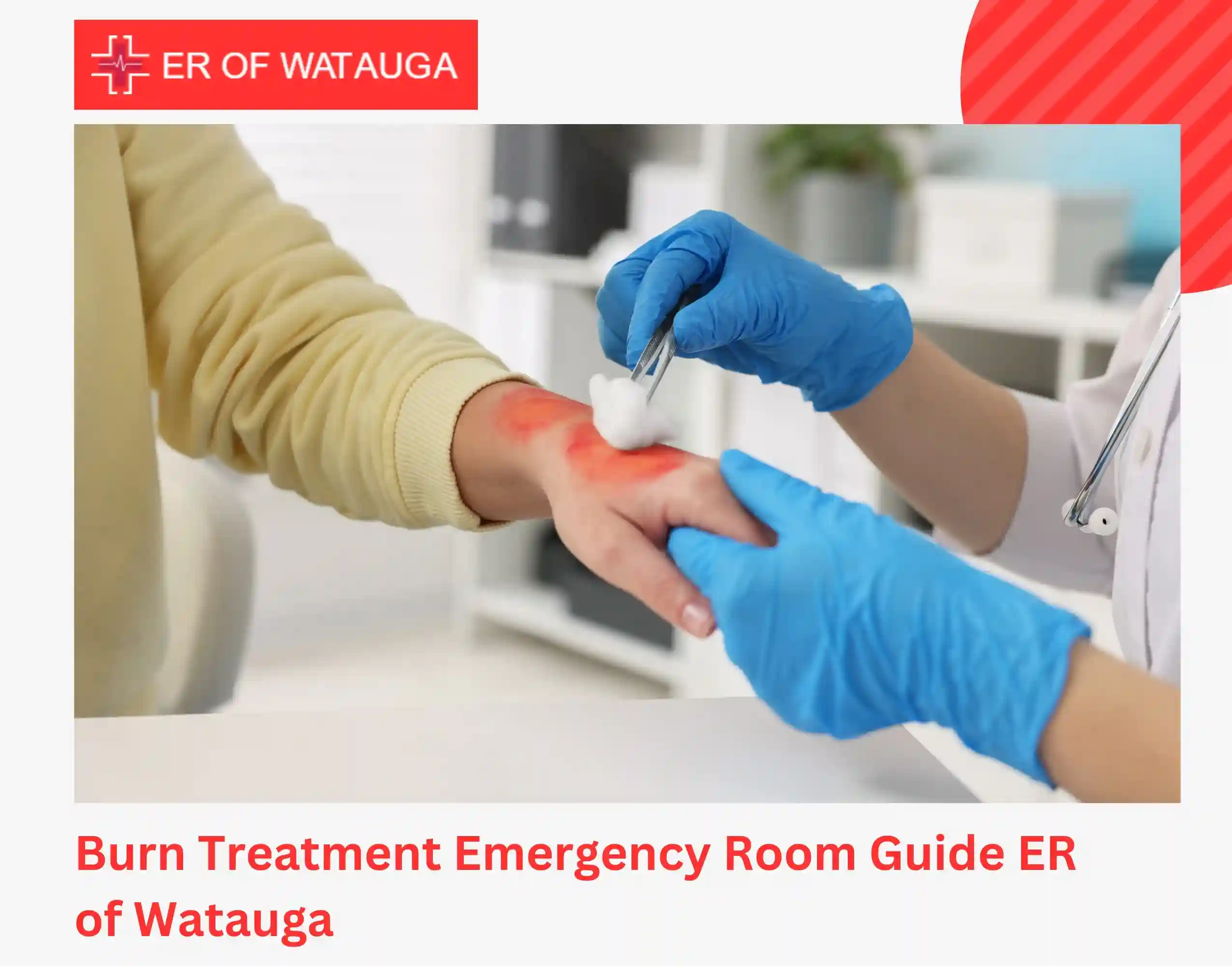
| CALL 911 FOR A SEVERE BURN Call 911 for burns that cover more than 10% of the body, burns to the face, hands, feet, or groin, electrical burns, chemical burns of the eyes, or burns with blackened, leathery, or bright-white skin. If you’re deciding when to go to the ER for a burn less severe than that, ER of Watauga is open 24/7. Call (817) 945-5500 or walk in. |
A serious burn can look mild for the first few minutes, then blister, swell, and worsen within an hour. Knowing when burn treatment emergency room care is needed, and not just a home first-aid kit2, is what protects skin, prevents infection, and preserves function. Second- and third-degree burns damage more than the surface, and once tissue crosses that line, waiting turns a treatable injury into a permanent one.
What Counts as a Burn Emergency?
A burn becomes an emergency when it involves deep skin damage, covers a large area, affects a sensitive region, or comes from a source beyond simple heat. Any second- or third-degree burn, any burn larger than three inches, and any burn on the face, hands, feet, or genitals belongs in the ER.
Use this quick check to sort what you’re looking at:
- Larger than 3 inches across, or roughly the size of a palm
- Located on the face, hands, feet, groin, or over a major joint
- Blisters that are broken, weeping, or spreading
- Skin that looks white, waxy, leathery, or charred
- Loss of sensation in or around the burn
- Caused by electricity, chemicals, or steam under pressure
- Circles all the way around an arm, leg, finger, or torso
- Occurs in a child, older adult, or someone with a chronic illness
Any of these features moves the burn out of home-care territory and into a burn treatment emergency room decision.
What Does a Second-Degree Burn Look Like?

A second-degree burn damages the outer layer of skin and part of the dermis beneath it. The area appears red, wet, or shiny, and blisters form within minutes to hours. Second-degree burn treatment focuses on preserving intact blisters, preventing infection, and managing pain during healing.
Signs You’re Looking at a Second-Degree Burn
- Bright red or blotchy red skin
- Blisters filled with clear fluid
- Skin that looks wet, weeping, or shiny
- Significant swelling around the injured area
- Deep, sharp pain when touched or exposed to air
- Skin that stays painful for hours after the burn happened
Small second-degree burns on limited areas can sometimes be managed at home. Larger ones, blistered burns on sensitive areas, or burns that keep worsening after cooling belong in the ER. If you’re still deciding when to go to the ER for a burn like this, the safer answer is usually yes. Second-degree burn treatment is time-sensitive because the deeper the damage runs, the higher the risk of infection and scarring. If any part of the burn area looks white, brown, or leathery, second-degree burn treatment emergency shifts into third-degree territory and needs the ER right away.
What Does a Third-Degree Burn Look Like?
A third-degree burn destroys the full thickness of skin and often the tissue beneath it. The area may look white, brown, black, or leathery, and it usually does not hurt at the burn site because nerve endings are destroyed. Every third-degree burn emergency requires an ER.
Signs You’re Looking at a Third-Degree Burn
- White, brown, black, or charred appearance
- Dry, leathery, or waxy skin texture
- Little or no pain in the deepest part of the burn (nerves are damaged)
- Surrounding areas of second-degree burn that ARE painful
- Skin that appears sunken or depressed compared to nearby tissue
- Visible fat, muscle, or bone in severe cases
A third-degree burn emergency needs immediate evaluation. Fluid loss, shock, and infection can develop within hours, and preserving function depends on how quickly the wound is stabilized. Do not treat a third-degree burn emergency at home. Call 911 or come directly to the ER.
How Do You Tell a Serious Burn from a Minor One?
Burn severity is measured by depth, size, and location. Depth determines the degree. Size determines fluid loss and infection risk. Location determines whether function, appearance, or airway are threatened.
Here is the quick reference:
| Degree | Appearance | Pain Level | Where to Go |
| First-degree | Red, dry, no blisters (like a sunburn) | Mild to moderate | Home care |
| Second-degree | Red, wet, shiny, with blisters | Sharp, significant | ER if larger than 3 inches, on face/hands/feet/groin, or in a child |
| Third-degree | White, brown, black, leathery | Little to none in the burn itself | Emergency room. Always. |
| Fourth-degree | Charred, may show muscle or bone | None in burn site | Call 911. Do not move alone. |
When to Go to the ER for a Burn
Come to the ER for any burn that is deep, wide, in a sensitive area, or caused by something other than simple heat. Waiting past the first few hours raises the risk of infection, shock, and permanent tissue damage. When to go to the ER for a burn, and when burn treatment emergency room care is the right call, are questions best answered fast.
Go to the ER Immediately If:
- The burn is second- or third-degree
- The burn is larger than 3 inches across
- The burn is on the face, hands, feet, groin, or crosses a joint
- The burn goes all the way around an arm, leg, or torso
- The burn was caused by electricity, chemicals, or steam
- You inhaled smoke or the burn is near the airway
- The person burned is under 5 or over 65
- There is fever, chills, or worsening pain 24-48 hours after the burn
- The burn shows signs of infection: pus, spreading redness, warmth, or foul smell
For anything on this list, walk into ER of Watauga or call 911. Freestanding emergency rooms handle the same acute burn care as a hospital ER, with faster access and shorter wait times.
First Aid Before You Get to the ER
Cool the burn, cover it loosely, and get moving. Correct first aid in the first 10 minutes can lower the severity of a burn by a full degree. Wrong first aid, such as ice or butter, can make it worse.
Follow these steps:
- Stop the burning source.
Move away from heat, remove smoldering clothing, or rinse chemicals with running water for at least 20 minutes.
- Cool the burn with running water.
Use cool (not cold) tap water for 10 to 20 minutes. Do not use ice. Ice damages already-injured tissue.
- Remove tight items.
Take off rings, watches, belts, or tight clothing near the burn before swelling starts.
- Cover loosely with a clean, non-stick material.
A clean cloth or plastic wrap works. Skip fluffy cotton, which sticks to the wound.
- Do not break blisters.
Intact blisters protect the skin underneath. Broken blisters raise infection risk.
- Do not apply butter, oil, toothpaste, or home remedies.
They trap heat, introduce bacteria, and make treatment harder when you reach the ER.
- Head to the emergency room.
For anything past first-degree, don’t wait. Call ahead if possible so the team is ready.
What Burn Treatment Emergency Room Care Looks Like

At ER of Watauga, burn treatment emergency room care begins the moment you walk in. Our board-certified emergency physicians assess depth, size, and location, then start immediate care to control pain, prevent infection, and preserve function. Every burn is treated as time-sensitive.
A typical burn visit includes:
- Rapid assessment of burn depth, size, and body-surface percentage
- Cooling and careful cleaning of the wound
- Removal of loose or dead tissue when needed
- Pain management appropriate to the severity
- IV fluids for larger burns to prevent shock and dehydration
- Sterile dressings and clear wound-care instructions
- Tetanus updates when indicated
- Coordination with a burn specialist or transfer to a burn center for severe cases
Because burns often overlap with other skin injuries, our team also evaluates for related trauma. For deeper open wounds accompanying a burn, our wound care guide explains what to expect during that side of care.
Freestanding emergency rooms are equipped for full acute burn treatment. Serious burns needing surgical care are stabilized on-site and transferred to a burn center. Transfer isn’t a limitation, it’s part of getting the right care at the right facility.
Why Choose ER of Watauga for Burn Treatment

For a burn that needs emergency evaluation, minutes matter. Our facility gives you the imaging, IV capability, and physician expertise of a hospital ER without the long wait. We treat burns for patients of every age, day or night, walk-in only.
What makes us different:
- Open 24 hours a day, 7 days a week, including holidays
- Board-certified emergency physicians on-site at all times
- Minimal wait, most patients seen within minutes
- Full diagnostic capabilities including CT, X-ray, ultrasound, and on-site lab
- IV-capable rooms for larger burns needing fluid resuscitation
- Pediatric and adult burn evaluation under one roof
- Direct coordination with regional burn centers when specialized care is needed
- In-network with most major insurance plans, no surprise billing
Walk into ER of Watauga any time. No appointment. No triage backlog. Just fast, expert burn treatment emergency when you need it.
Frequently Asked Questions
How big does a burn have to be to go to the ER?
Any burn larger than 3 inches, roughly the size of a palm, warrants emergency evaluation. Smaller burns on the face, hands, feet, groin, or over a joint also need the ER regardless of size.
Can I treat a second-degree burn at home?
Small second-degree burns on limited areas sometimes heal well with cool water and clean dressings. Larger blistered burns, burns on sensitive areas, or worsening burns need emergency evaluation to prevent infection and scarring.
Should I pop a blister from a burn?
No. Intact blisters protect the skin underneath and lower infection risk. If a blister breaks on its own, leave the loose skin in place and cover it with a clean, non-stick dressing until you reach the ER.
How long does a second-degree burn take to heal?
Most second-degree burns heal within 2 to 3 weeks with proper care. Deeper burns take longer and may leave changes in skin color or texture. Prompt second-degree burn treatment lowers the risk of scarring and infection.
What is the difference between urgent care and an ER for a burn?
Urgent care handles minor first-degree burns. Burn treatment emergency room care is required for second- and third-degree burns, burns on sensitive areas, chemical or electrical burns, and any burn showing signs of infection or shock.
Get Burn Care Now
For any burn that meets the emergency criteria in this guide, walk into ER of Watauga. We’re open 24 hours a day, staffed by board-certified emergency physicians, and equipped for full acute burn treatment. When burn treatment emergency needs an emergency room, this is what one looks like.
Open 24/7. No appointment needed.
| Call: (817) 945-5500 Visit: 5401 Basswood Blvd, Fort Worth, TX 76137 Hours: Open 24/7 |


